


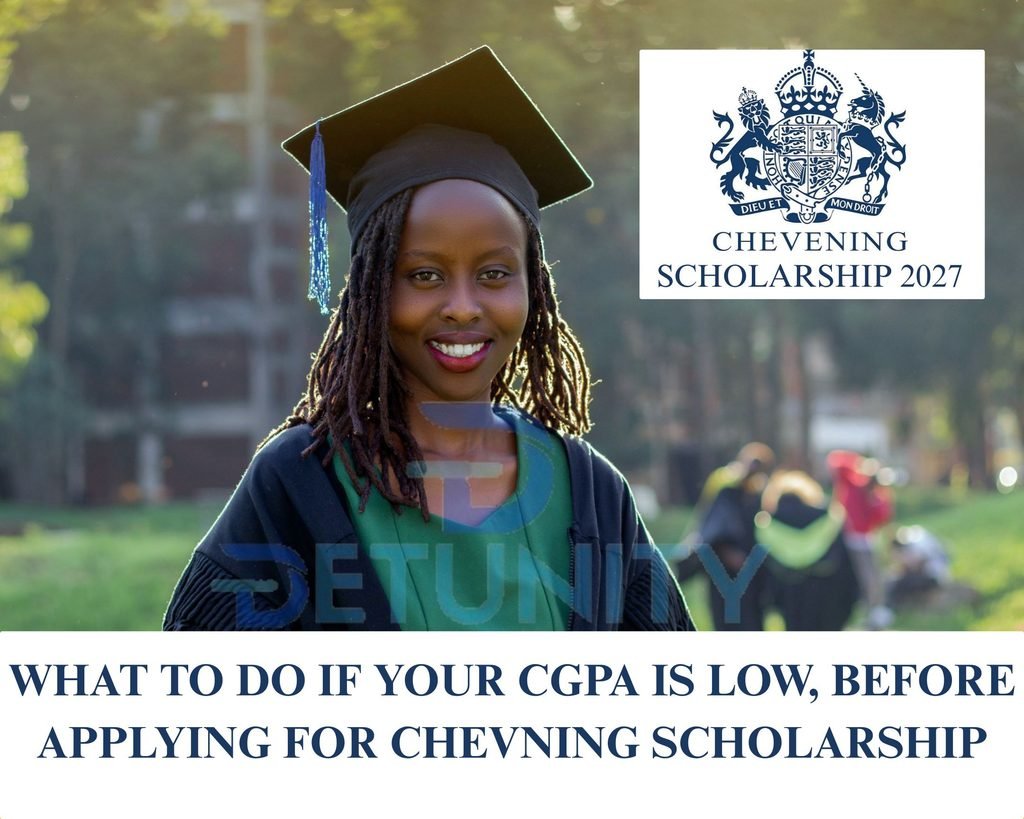
If you are planning to apply for the Chevening Scholarship, you may be wondering, “What CGPA do I need for Chevening?” This is one of the most common questions among scholarship applicants, especially students and graduates from Nigeria.
The important thing to understand is that Chevening does not publish a specific minimum CGPA such as 3.0, 3.5, or 4.0 as its general academic requirement.
Instead, applicants must hold an undergraduate degree that qualifies them for entry onto a postgraduate programme at a UK university. Chevening states that this is typically equivalent to a UK upper second class, or 2:1, honours degree.
However, meeting the Chevening academic requirement is only one part of the application. Your chosen UK universities will also assess your academic qualification and determine whether you meet the admission requirements for your selected master’s courses.
Quick Answer: What CGPA Do I Need for Chevening?
Does Chevening have a fixed CGPA cutoff?
No. Chevening does not state one universal minimum CGPA.
What academic level does Chevening expect?
You need an undergraduate degree that qualifies you for entry to a UK master’s programme, typically equivalent to a UK 2:1.
Can a university require a higher CGPA?
Yes. Individual universities and courses can have their own admission requirements.
Does a high CGPA guarantee Chevening selection?
No. Academic qualifications are only one part of the application.
Does Chevening Have a Minimum CGPA?
No, Chevening does not state a universal minimum CGPA such as 3.0 or 3.5 on its general eligibility guidance.
Instead, Chevening requires applicants to hold an undergraduate degree that qualifies them for entry onto a postgraduate programme at a UK university. Chevening describes this as typically equivalent to an upper second class, or 2:1, honours degree in the UK.
This distinction is important because universities in different countries use different grading systems. Even within Nigeria, grading structures and academic requirements can vary between institutions.
Therefore, you should not assume that a particular CGPA automatically makes you eligible or ineligible for Chevening.
Why Does Chevening Not Give One CGPA Number?
Chevening applicants come from many countries and different educational systems. A CGPA cannot always be compared directly across different universities and countries.
The more useful question is whether your undergraduate qualification allows you to gain admission to an eligible master’s programme at a UK university.
Chevening advises applicants to check the requirements of their individual universities when determining whether their degree meets the required standard.
What CGPA Is Competitive for Chevening?
There is no official Chevening CGPA that can be described as the competitive cutoff.
You may see websites, social media posts, or scholarship forums claiming that applicants need a specific CGPA, such as 3.5 or 3.7, to win Chevening.
You should not treat these figures as official Chevening requirements unless they are supported by current information from Chevening.
A strong academic record can strengthen your overall profile, but Chevening selection is not based on CGPA alone.
Your application should also demonstrate qualities and experiences that show your potential as a future leader and your ability to create meaningful impact.
What Else Matters Besides CGPA?
When preparing your application, pay attention to:
• Leadership experience and potential.
• Networking and relationship building.
• Relevant professional experience.
• Clear short term and long term career goals.
• Your reasons for choosing your proposed courses.
• The connection between your studies and your future career.
• The quality of your application essays.
• Your professional and academic references.
Your goal should be to present a complete application rather than relying on your academic result alone.
Can I Apply for Chevening With a Low CGPA?
It depends on whether your undergraduate qualification allows you to meet the admission requirements for an eligible UK master’s programme.
Chevening does not publish a universal CGPA number that defines a “low CGPA.” Therefore, you should not automatically assume that having a lower CGPA means you cannot apply.
However, you also should not assume that every CGPA will meet the academic requirements of every UK university.
For example, a particular university may require a specific degree classification or academic standard for a master’s programme. Another university may have different requirements.
What Should You Do If Your CGPA Is Low?
Start by researching your intended universities and courses.
Check the official admission requirements for each course and determine whether your academic qualification meets the stated standard.
If your preferred course requires a higher academic result than you have, research other eligible courses whose requirements are compatible with your academic background.
Do not choose a course simply because you think it has easier requirements. Your course choices should also support your professional background and long term career goals.
Does Your CGPA Affect Chevening University Admission?
Yes. Your academic record can affect university admission even though Chevening does not publish one universal CGPA cutoff.
Chevening and UK universities perform different roles in the scholarship process.
Chevening assesses your scholarship application against its eligibility and selection requirements. Your chosen university assesses whether you meet the admission requirements for its specific master’s programme.
This means that meeting Chevening’s eligibility requirements does not automatically guarantee admission to every UK university.
Check Your University Requirements Before Applying
Before selecting your courses, check the official university website for:
• Minimum degree classification.
• International qualification requirements.
• Subject requirements.
• Relevant professional experience requirements.
• English language requirements.
• Required application documents.
• Any additional academic conditions.
This is more reliable than using a general CGPA number found on social media or an unofficial scholarship website.
How to Strengthen Your Chevening Application
If you are concerned that your CGPA is not exceptionally high, focus on strengthening the other areas of your application.
- Show Strong Leadership Evidence
Do not simply describe yourself as a leader.
Give specific examples of situations where you took responsibility, coordinated people, led an initiative, solved a problem, or helped create measurable change.
Explain what you did, why you did it, what happened, and what you learned from the experience.
- Build Relevant Work Experience
Chevening requires applicants to meet its work experience requirement. This can include qualifying full time employment, part time work, voluntary work, and paid or unpaid internships, subject to the current Chevening rules.
Make sure your experience meets the current definition before submitting your application.
- Create a Clear Career Plan
Your application should explain where you want your career to go and why studying in the UK is important to that plan.
Explain the problem you want to address, the skills you need, how your proposed master’s course will help you develop those skills, and how you intend to use the knowledge after your studies.
- Choose Your Courses Carefully
Your three course choices should make sense in relation to your academic background, professional experience, and future career goals.
A strong application should make it easy for the reader to understand why these particular courses are important to your career development.
- Write Evidence Based Essays
Avoid filling your essays with general statements such as “I am passionate,” “I am hardworking,” or “I am a great leader.”
Instead, provide evidence.
Describe specific experiences and explain the actions you took, the results you achieved, and the lessons you learned.
- Choose Strong Referees
Your referees should know you well enough to provide meaningful information about your academic, professional, leadership, or personal qualities.
Choose people who can provide specific examples rather than simply confirming that you are a good candidate.
- Check English Language Requirements
Chevening itself no longer requires applicants to meet a separate Chevening English language requirement. However, your chosen university may still require proof of English proficiency for admission.
Always check the current requirements of each university and course you select.
Common Mistakes Applicants Make About CGPA
Mistake 1: Assuming There Is a Fixed 3.5 CGPA Rule
Chevening does not publish a universal 3.5 CGPA requirement. Do not treat an unofficial CGPA figure as an official eligibility rule.
Mistake 2: Assuming First Class Is Compulsory
Chevening does not state that applicants must have a first class degree. Its academic requirement focuses on having an undergraduate qualification that enables entry to a suitable UK postgraduate programme, typically equivalent to a UK 2:1.
Mistake 3: Ignoring University Admission Requirements
Being eligible for Chevening does not automatically mean that every UK university will accept your academic qualification.
You must check the requirements for each course you intend to select.
Mistake 4: Focusing Only on CGPA
A strong CGPA does not replace the need for a convincing scholarship application.
Your leadership experience, networking skills, work experience, career goals, course choices, essays, and references can all contribute to your overall application.
Mistake 5: Using Outdated Information
Scholarship requirements can change between application cycles.
Always check the current Chevening guidance and the official websites of your selected universities before submitting an application.
Frequently Asked Questions
Chevening does not publish one universal minimum CGPA. Applicants need an undergraduate qualification that enables them to gain entry to an eligible UK master’s programme, typically equivalent to a UK upper second class, or 2:1, honours degree.
Does Chevening have a minimum CGPA?
Chevening does not state a specific CGPA cutoff for all applicants. Your academic qualification must meet the standard required for entry to a suitable UK postgraduate programme.
Can I get Chevening with a 2.5 CGPA?
You should not assume that a 2.5 CGPA automatically qualifies or disqualifies you. The important consideration is whether your qualification meets the academic requirements for an eligible UK master’s programme. Check the official requirements of your selected universities before applying.
Can I apply for Chevening with a third class degree?
Do not assume that a third class degree automatically meets the Chevening academic requirement. Chevening states that your undergraduate qualification must enable you to gain entry to a UK postgraduate programme, typically equivalent to a UK 2:1.
You should check your qualification against the requirements of your intended universities.
Does Chevening require a first class degree?
No. Chevening does not state that applicants must have a first class degree. Its guidance refers to an undergraduate qualification that typically corresponds to a UK upper second class, or 2:1, degree.
Does Chevening look at CGPA?
Your academic qualification matters because you must hold an undergraduate degree that enables you to enter a suitable UK master’s programme. However, Chevening does not publish a single CGPA cutoff for all applicants.
Does a high CGPA guarantee a Chevening Scholarship?
No. A high CGPA does not guarantee selection. Chevening also considers areas such as leadership potential, networking skills, career goals, work experience, and the suitability of your chosen courses.
Related Posts
Chevening Scholarship 2027/28: A Nigerian Applicant’s Strategic Guide
Why Your Scholarship Applications Keep Getting Rejected (And How to Fix It)
Can You Get a Fully Funded Scholarship with a Low CGPA? Here is the Strategy
Conclusion
So, what CGPA do you need for Chevening?
There is no single official CGPA cutoff that applies to every Chevening applicant.
Instead, you need an undergraduate qualification that enables you to gain entry to a suitable UK master’s programme. Chevening describes this as typically equivalent to a UK upper second class, or 2:1, honours degree.
Your next step should be to check the academic requirements of the UK universities and courses you want to study.
If your academic record is not exceptionally high, focus on building a strong overall application through leadership experience, relevant work experience, clear career goals, suitable course choices, strong essays, and meaningful references.
Do not reject yourself simply because you do not have a perfect CGPA. At the same time, do not rely on unofficial CGPA claims.
Always check the latest Chevening requirements and your chosen university’s admission requirements before applying.
Discover more from Detunity Scholarships
Subscribe to get the latest posts sent to your email.




Since you’re looking into Chevening, you’re likely planning for a career that doesn’t necessarily require you to be tied to one office. While focusing on the CGPA requirements, it’s also worth building up some international work experience to make your application stronger. I actually put together a Telegram feed that tracks global remote jobs and paid internships for people who want to work with international companies regardless of where they are based. It’s just a straightforward list of openings without the usual job board noise. If you’re looking for a remote role to add to your CV while you prep your scholarship docs, you can check it out here: https://clck.ru/3Vr2qm
Hope this helps someone find their next role.
Since you’re looking into Chevening, you’re likely planning for a career that doesn’t necessarily require you to be tied to one office. While focusing on the CGPA requirements, it’s also worth building up some international work experience to make your application stronger. I actually put together a Telegram feed that tracks global remote jobs and paid internships for people who want to work with international companies regardless of where they are based. It’s just a straightforward list of openings without the usual job board noise. If you’re looking for a remote role to add to your CV while you prep your scholarship docs, you can check it out here: https://clck.ru/3Vr2qm
Hope this helps someone find their next role.